Seven Steps of Siddhārtha
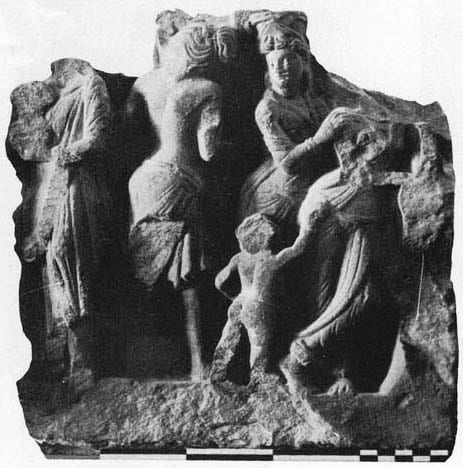
©GrandPalaisRmn - Guimet Museum

Description
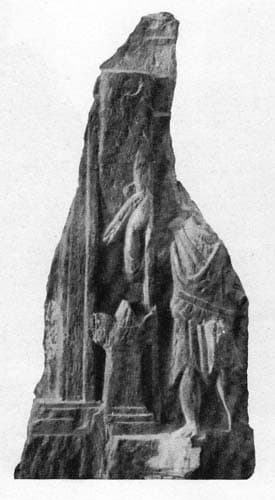
It is a fragment of a relief broken on all sides. At the far right of the relief stands a woman dressed in a dhotī held up by a belt and wearing anklets, whose head has disappeared. Her peculiar position, leaning on her left leg, with her right leg bent forward, reveals her to be Māyā at the time of Siddhārtha's birth in Lumbīni Park. The queen is supported by Indra. Dressed in a long robe and wearing a high headdress, he still holds the clean cloth that was used to collect the child. Behind him, from behind, shirtless and wearing the languṭi is Brahma. His long, straight hair is gathered up in a bun in the manner of his disciples. The scene appears to be an intermediate episode or a continuing narrative of the birth and first seven steps of the Buddha. The Buddha, seen from behind, standing naked, raises his arm towards his mother's hip in a gesture. To the left of the relief, an unspecified figure has his back to the scene.
Observations
The schist reliefs discovered by Barthoux between 1926 and 1928 are mostly from the vicinity of the Great Stūpa K1 of Tapa-i Kafarihā, the south-western part of the main stūpa B12 of Bāgh Gaï (around B13) and the Great Stūpa TK140 of Tapa Kalān.
Characteristics
Dimensions
H: 29cm × L: 29cm
Technique
Sculpture
Material
Schist
Object type
Historiated bas-relief
Site
Haḍḍa, lost location
Conservation location
National Museum of Afghanistan
Museum inventory No.
KM 62-3-439
Traces of polychromy
No
Restoration
No restoration
Dimensions
H: 29cm × L: 29cm
Technique
Sculpture
Material
Schist
Object type
Historiated bas-relief
Site
Haḍḍa, lost location
Conservation location
National Museum of Afghanistan
Museum inventory No.
KM 62-3-439
Traces of polychromy
No
Restoration
No restoration
Bibliographic References
Other objects from Haḍḍa, lost location
Part of the themed routes