Tapa-e Shotor
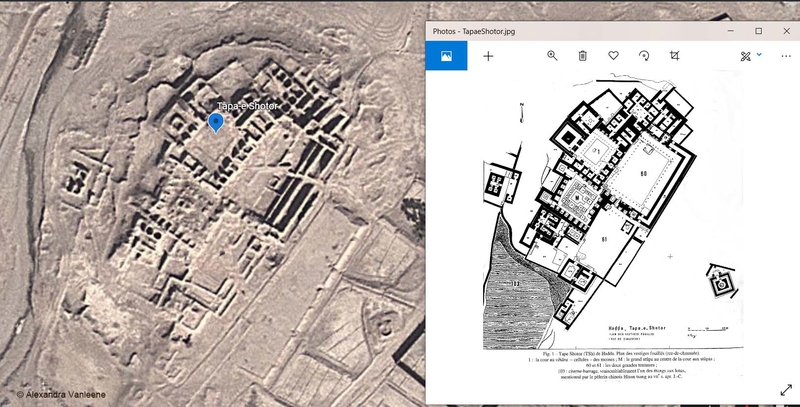
Perspective view of the plan of Tapa-e Shotor drawn by Pr. Z. Tarzi (Tarzi, 1997) and the current state of the site according to Google Earth satellite imagery.
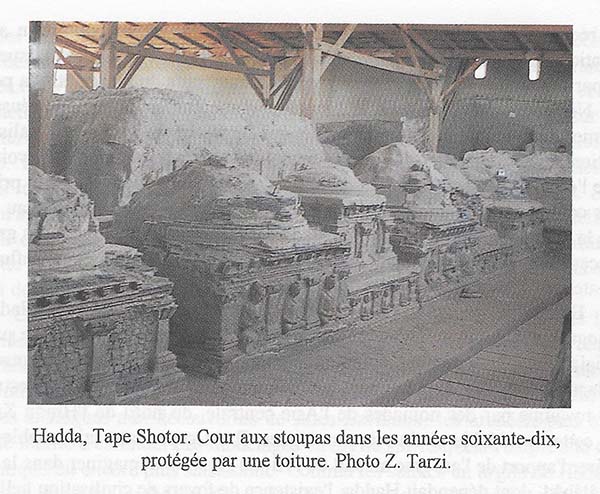
The excavations of Tapa-e Shotor (abbreviation: TSh), "The Camel Hill", were begun by Shaïbaï Mostamindi and continued by Zémaryalaï Tarzi. Tapa-e Shotor marked the northern limit of the monastic complex of Haḍḍa. The entrance was situated to the east, and one had to climb a few steps to reach the Stūpa Court. The monastery underwent considerable expansion. At its most extensive, it constituted a complete monastic complex with a public space comprising a Stūpa Court embellished by several terraces, surrounded by çaitya and niches entirely decorated with modellings, some of which were in clay. This public space adjoined a private area containing the vihāra, the assembly hall and the communal rooms, as well as the dwellings. The stratigraphic data supported by numismatic finds enabled Tarzi to refine the chronology and propose nine construction phases. This allows us to proceed with a chronological description of the remains, unlike the monasteries excavated by Barthoux.
TSh I corresponds to the beginning of pre-monastic settlements and is dated from Azes II (35-12 BCE). TSh II, the first Buddhist period, is contemporary with the reign of Huviṣka in the second half of the 2nd century CE (155-187). TSh III falls between the end of Huviṣka's reign and the beginning of that of Vasudeva I. TSh IV corresponds to the reign of Vasudeva (191-225). A first hiatus occurs between Vasudeva and his successors. TSh V extends from the post-Vasudeva period to the last Kušan, until approximately the mid-4th century CE. TSh VI corresponds to the seizure of power by Kidara and extends from the mid-4th to the 5th century. TSh VII falls in the 5th century, TSh VIII (corresponding to TTK I) in the late 5th and the 6th century. There follows a second and very long hiatus of two and a half centuries, from the early 6th to the mid-8th century CE. Finally, TSh IX (corresponding to TTK II) extends from the mid-8th to the 9th century, a period at which a final fire destroyed the sites.
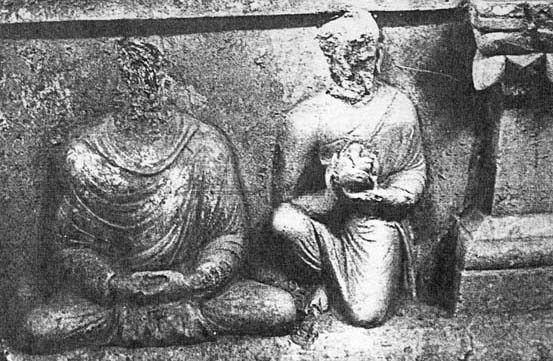
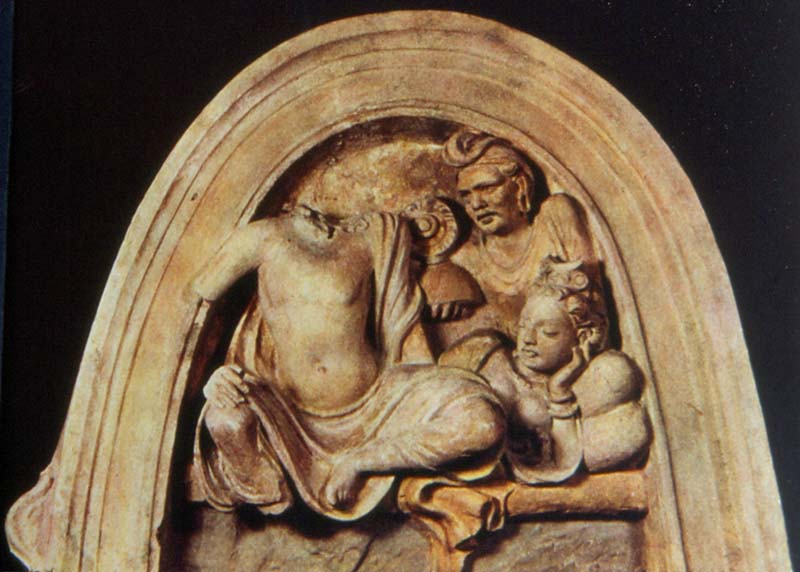
During the TSh II period, the Vihāra 1 was constructed along with Niches V1 (representing the Exhortation to Preach), V2 and V3 (both dedicated to the First Sermon), as well as the Stūpa Court and Niches IV to X and XIV to XVI that surrounded it. Niche VI depicted the First Sermon, Niche XVI the Visit of Indra to the cave of Indraśala, and Niches IX and XIV, the Buddhist heavens. The second Buddhist phase TSh III corresponds to the construction of the Great Stūpa M (decorated with a Visit of Indra) and the secondary stūpa 10 and 11, as well as the enlargement of Terrace 60. TSh IV saw the construction of the Assembly Hall 10, the refectory 13, the forecourt 14 and the court 42. Around Terrace 60, a tower was transformed into Caitya EXXIV (containing stūpa 39), entirely decorated in honour of the Buddhas of the past, one niche of which, EXXIVb, depicted the Miracle of Śrāvastī. Also during this period, the Vihāra 43 was built, Terrace 61 was laid out, as well as Caitya 59 containing stūpa 40 and a few secondary stūpa around the Stūpa Court. Of note are stūpa 6, bearing a representation of the First Sermon, stūpa 20 whose second tier was decorated with the Offering of a Handful of Dust and the Jātaka of the Subdued Lion, and stūpa 25 where a scene of the Offering of a Handful of Dust was depicted.
During TSh V, the Vihāra 1 was enlarged with rooms 16 to 18, Terrace 60 was enriched with Niches EV, EXI to EXXIII, the Stūpa Court saw the construction of Niches I to III, the Vestibule XI and Chapel XII representing the Buddhist heavens, the so-called "aquatic" Niche XIII and Niches XVII, XIX to XXIV, as well as the rearrangement of several stūpa (2, 3, 4, 7, 8, 13, 18, 19, 27).
During TSh VI, the Vihāra 1 was again rearranged and enlarged with the construction of halls 52 to 56 and forecourt 99; around Terrace 60, Niches EVI and EVII as well as Caitya EVIII were built; the Stūpa Court acquired stūpa 17 and 26, dedicated to the mokṣa ceremony, and the painted decoration of Cave A representing the Ten Monks Protectors of the Law as well as the Worship of the Bowl and Turban was executed. During the sixth Buddhist period TSh VII, repairs were carried out in the Vihāra 1, stūpa 1 and 20 were added to the Stūpa Court, Terrace 60 was enlarged and Niches EIX and EX were added to it. Finally, the reservoir 103, its dam 104 and the thermal complex 70 to 73 were built. The last periods TSh VIII and IX are equivalent to TTK I and II. At TSh only repairs took place.
Explore the objects from this site in the database or on the interactive map.