Haḍḍa
Haḍḍa is the name of a modern village in Afghanistan, located about ten kilometers south of the present-day city of Jellālābād (formerly Nagarahāra), built upon the ruins of a small pre-Islamic town on which depended an important Buddhist monastic complex, flourishing from the early centuries of the Christian era. By eponymy, Haḍḍa also designates the artistic school responsible for creating the decoration of the monasteries, celebrated for its sculpted works of remarkable aesthetic refinement. The saṃgharama of Haḍḍa, governed by the Theravāda sect of the Sarvāstivādin, were among the major religious centers welcoming pilgrims traveling along the Silk Road between India and China via Gandhāra. Located at the gates of India, near a cave where, according to legend, the Buddha Śakyamuni is said to have left his shadow, and reputed to have housed some of his relics, these prosperous monasteries were inhabited by generations of monks and visited by just as many devoted Buddhists until the ninth century of the Christian era. During the Ghaznavid era, the monasteries were pillaged and destroyed by a widespread fire. Forgotten for nearly eight hundred years, the site was rediscovered in the nineteenth century.
The memory of the saṃgharama of Haḍḍa was preserved in the chronicles recorded by Buddhist pilgrim-travelers from China. Shih Faxien, whose journeys are known to us through his "Account of the Buddhist Kingdoms" (Foe Kuo Ki), reported having seen "1000 stūpa" erected around Haḍḍa during his passage through the region, around the year 400 of the Christian era. In 530, Songyun, sent on an official mission to India by a Wei empress to collect ancient sūtra, also visited the region. He recounted an episode during which the monasteries were abandoned, attributing this to the ferocity of the Hunnic sovereign Mihirakula. Finally, Xuanzang, the most famous of these travelers, departed around 627 and, around 634, visited the region of Jellālābād, the kingdom of Na-kie-lo-ho (Nagarahāra), passing through Haḍḍa. In his Si-Yu-Ki, "Account of a Journey to the West," he describes a region of lush vegetation and flourishing monasteries organized around a firmly established relic cult, attracting numerous pilgrims and ensuring its prosperity.
Xuanzang relates: "About thirty li southeast of the capital Na-kie-lo-ho, one arrives at the city of Hi-lo (Haḍḍa), whose circumference is four or five li. It is situated on elevated ground and defended by natural obstacles. One sees flowering groves and ponds with water as clear as a mirror. There is a two-story tower; the beams are painted and the columns are red."
On the second floor, there is a small stūpa constructed with seven precious materials, in which the bone from the top of the skull of the Thatāgatha has been deposited. The circumference of this bone is one foot and two inches; one can clearly discern the holes of the hair follicles; its color is yellowish-white. It is enclosed in a precious casket placed at the center of a stūpa. Those who wish to know the measure of their virtues or sins make a soft paste with perfumed earth and use it to mold the skull bone, whose features appear on the paste according to the influence of their virtue.
There is also another small stūpa, made of the seven precious substances, which contains the skull bone of the Thatāgatha. Its shape is similar to that of a lotus leaf; its color is identical to that of the other, and it is likewise contained in a precious box, sealed and closed.
There is also another small stūpa, made of the seven precious substances, in which the eyeball of the Thatāgatha is deposited, about the size of an Ᾱmra fruit, shining and clear throughout; it too is housed in a precious box, sealed and closed. The Saṃghāṭi of the Thatāgatha, made of a fine cotton fabric of yellow-red color, is likewise enclosed in a precious box. As many months and years have passed, it is somewhat damaged. The staff of the Thatāgatha, whose rings are made of white iron (tin?) and whose handle is of sandalwood, is contained in a precious case (a case made of a precious substance). Recently, a king, having heard of these various objects that once belonged to the Thatāgatha as personal effects, forcibly took them to carry them to his own country and placed them in his palace. Shortly thereafter, when he went to inspect them, they had disappeared; and after further investigations, he discovered that they had returned to their original location. These five sacred objects (relics) often produce miracles.
The king of Kapiça ordered five pure men (brāhman) to watch over the relics and continually offer them incense and flowers. These pure individuals, observing the crowds who came to worship incessantly and wishing to devote themselves to peaceful meditation, established a fixed pricing system in order to maintain order, by means of this wealth so highly valued by men. In summary, those who wish to see the bone from the top of the head of the Thatāgatha must pay one gold coin; and to take an impression of the bone, they must pay five. The other objects, each in its place, have a fixed price; and yet, although the fees are considerable, there are many worshippers.
To the northwest of the two-story pavilion stands a stūpa, not very tall, but which nevertheless possesses numerous spiritual (miraculous) qualities. If one merely touches it with a finger, it trembles and quivers all the way to its base, and the small bells and chimes moving together produce a pleasant sound. Heading southeast from there, crossing mountains and valleys for about 500 li, we arrive at the kingdom of Kien-t'o-lo (Gandhāra).
The excavations carried out at Haḍḍa can be classified into three phases with very different objectives and results. In the nineteenth century, the first research projects focused mainly on the discovery of ancient coins. Based on ancient Chinese testimonies, the French general Claude-Auguste Court identified the site around 1825, noting the existence of the "very ancient" ruins of "Hedde," where he discovered numerous artifacts and ancient coins, Greco-Bactrian, Indo-Scythian, Roman, and Hephthalite.
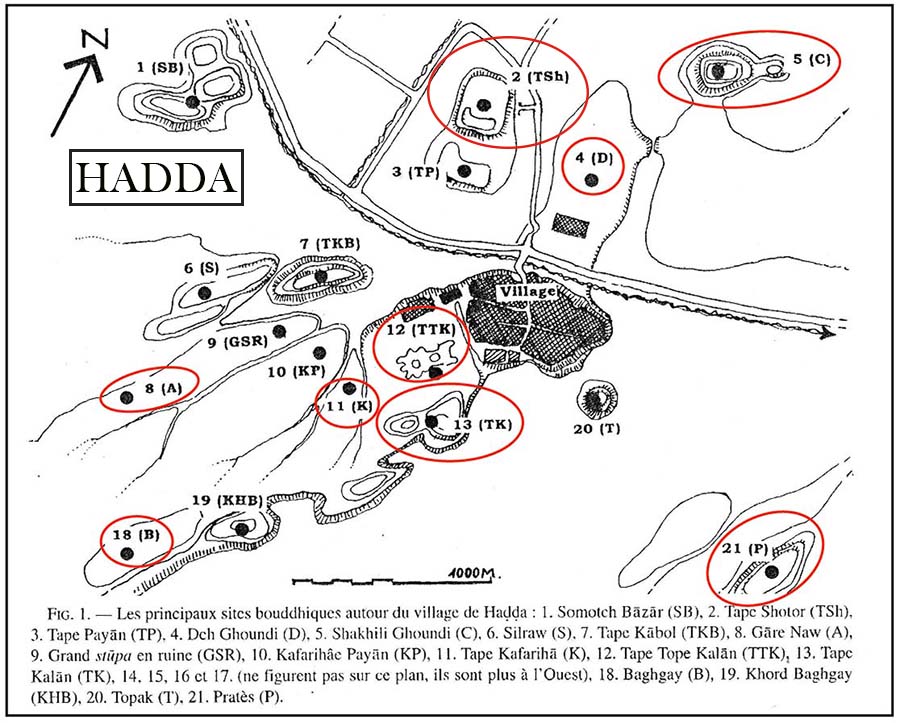
From 1832 to 1838, Charles Masson, working for the East India Company, was tasked with exploring the archaeological ruins of Afghanistan. He first explored Bāmiyān, then studied more than a hundred Buddhist sites around Kaboul, Jellālābād, and Wardak, producing numerous drawings of the sites as well as maps, stūpa cross-sections, and sketches of his discoveries. In 1834, Masson undertook excavations at Haḍḍa. He noted that the region resembled a varied collection of mounds, tumuli, and caves. In accordance with his objectives, he opened stūpa in order to search for relics. Masson excavated sixteen structures, eight small mounds, four large mounds, and four tumuli. Only thirteen of these structures were included in his report in Ariana Antiqua (Masson 1841, Haḍḍa 1–8, 10–13, Tepe Kelan). The descriptions of "Haḍḍa 13" to "Haḍḍa 16" are missing. According to Elizabeth Errington, the list is too obscure to allow precise identification of the sites. In 1835, Masson excavated "Haḍḍa 9" and continued his explorations at Tape Kalān. There he discovered numerous reliquaries (in steatite, gold, ivory, etc.) containing precious stones (crystal, ruby, aquamarine, etc.), rings, small ornaments in gold and metal, shells, plant seeds, bones, and teeth, and above all, a considerable quantity of coins. In stūpa no. 10 at Tapa Kalān, he reported having discovered Greco-Bactrian, Indo-Scythian, and Kushan coins, as well as coins of the Domitians, Theodosius, and Leo, accompanied by Hephthalite and Nspk coins. The importance of Haḍḍa, whose monasteries appeared to have been active over a very long period, became evident. The sculptures, although attracting less attention at the time, were also among the discoveries. In a letter dated July 6, 1834, Masson noted: "Independent of the topes, the mounds and tumuli yield a considerable number of idols; I have procured eight and could probably obtain hundreds if I can appease the clamors of the Mullahs who have assembled en masse and prevented my laborers from working." These local conflicts would mark all the archaeological campaigns at Haḍḍa, as elsewhere in Afghanistan over the centuries. Since the British East India Company financed these explorations, it received all of Masson's discoveries, which were sent to the India Museum in London. When that institution closed in 1878, the British Museum became the principal repository for all the archaeological finds as well as some of the coins.
The interference of the British East India Company in Afghan politics led to the First Anglo-Afghan War (1839–1842), during which access to the region was forbidden to the British until the Second Anglo-Afghan War (1878–1879). At that time, however, some explorations were undertaken by William Simpson. This artist and antiquarian accompanied the British armed forces led by General Sir Samuel Brown, spending four months around Jellālābād, visiting the vestiges of the past and attempting to identify the ancient Nagarāhāra. Following in Masson's footsteps, Simpson conducted several surveys during the autumn of 1879 at Tapa Kalān and Chakhil-i Ghoundi, and documented the results with several detailed descriptions and drawings. According to the local inhabitants, he took with him fragments of sculptures and bas-reliefs, traces of which remain at the British Museum.
As twenty-first-century archaeologists, we might be tempted to regret the mindset of the era and to label these early explorers as "treasure hunters" and these initial excavations as "looting." However, that would be judging these pioneering discoverers too quickly and easily, for they were not immune to the era in which they lived and, in their own way, were rigorous and meticulous in their collecting. The fact remains: it is thanks to these two nineteenth-century exploration campaigns that Masson and Simpson brought the Buddhist antiquities of Haḍḍa to the attention of the Western world.
In the twentieth century, true archaeological explorations began. In 1922, as part of the establishment of the Convention between France and Afghanistan, initiated by King (Emir) Aman-Ullah Khān, Alfred Foucher, a renowned specialist in Buddhism (particularly in the so-called "Greco-Buddhist" art of Gandhāra), was appointed the first director of the French Archaeological Delegation in Afghanistan (DAFA). In October 1922, after several decades during which the country had been closed to foreign missions, he led his first exploratory investigations across Afghanistan "with the help of the very precise account left by the Chinese pilgrim Hiuan-tsang, that ancient route of caravans and armies, pilgrims and artists."
In February 1923, he set off for Jellālābād, joining André Godard, an architect and archaeologist who had previously worked in Iraq and Egypt. Together, and accompanied by their wives, they conducted a systematic exploration of the ancient region of Nagarahāra in order to prepare the programs for the future, and initial, archaeological campaigns of the DAFA, taking a particular interest in Haḍḍa. Bolstered by the first accounts of exploration, Foucher undertook the first surveys at Tapa Kalān, "the Great Hill."
"The soundings carried out in the Buddhist convents of the Nagarahāra region proved fruitful" and "of extraordinary richness [...] in Buddhist ruins." From the very first discoveries, he took keen interest in the originality emanating from the art of sculpture, a decoration executed entirely (he said) in lime mortar, and remarked: "Mr. Godard's first sounding at Haḍḍa brought us [...] figurines and stucco heads exactly like those found as far as Taxila." Disappointed, as is well known, not to have found in Balkh the evidence that Bactria was a "Land of Art," Foucher initially had a rather mediocre image of Afghanistan. The discoveries made at Haḍḍa led him to revise that judgment and to realize that, on the contrary, the region was rich in its own cultural and artistic identity. He added that Sir John Marshall's excavations, particularly at the site of Jauliān in Taxila, were already paving the way for the interpretation of Haḍḍa and establishing the similarity between the artistic production of the region and that of Gandhāra, a notion reinforced by the discoveries made in 1907 by David Spooner during excavations at Takht-i-Bāhi, closer to the Afghan border. Foucher famously declared: "from Djellalabad to Rawalpindi, we were dealing with the same school of art."
The artistic production of the Haḍḍa school, exceptional in its aesthetic quality, the liveliness of its Western inspirations, which chiefly attracted the attention of scholars at the time, and its preferred materials, stucco and clay, nevertheless cast a different light on the art of Gandhāra, which had until then been primarily represented by stone bas-reliefs. Let us pause for a moment on the particular interest given to Western aesthetic influence. It is indeed worth noting that at the time, scholars were primarily endeavoring to demonstrate the influence of Western art on the art of this "exotic" region of Central Asia, as proof of the impact of Greco-Roman genius: this was the era of the so-called "Greco-Buddhist" art of Gandhāra from the French perspective, and of "Romano-Buddhist" art of Gandhāra from the British point of view. Allow this anachronism: later studies have shown that the art of Gandhāra in general, and the art of Haḍḍa in particular, bears the mark of numerous local and foreign artistic influences (Western certainly, but also Indian, Iranian, and Central Asian), just as they have revealed that sculpted artistic production extended to countless monasteries, from Pakistan to Chinese Central Asia.
Regarding iconography, Foucher speaks of a proliferation of stereotyped figures spread across all the interior walls of chapels and on the surfaces of stūpa, varying in size from one foot (about 50 cm) at the base to as little as 1 cm at the top. He adds that these figures of the Buddha and monks, of Bodhisattva and laypeople, of genii and demons bear traces of polychromy and gilding. He finally notes that many figures reflect the school's taste for the grotesque, the horrific, and the macabre. Today, in light of the discoveries made by later missions, one better appreciates how remarkable the Haḍḍa school was in the audacity and originality of its sculptors, both in their aesthetic and technical choices.
In March 1923, following the directions found in Charles Masson's Ariana Antiqua, André Godard continued the soundings in the Stūpa Courtyard. There he uncovered about twenty stūpa and particularly excavated "the central stūpa and adjacent convents with their square courtyards surrounded by cells, many of which themselves contain miniatures of stūpa" (E. Sénart). Godard states that "Each of these cells housed a small stūpa richly decorated with pilasters and bas-reliefs. Along the walls, in the doorway recesses, and even along the courtyard walls, a large number of Buddha statues of various sizes and from different periods were placed side by side, the smallest in front of the largest. The place, both in terms of the quality and quantity of statues and votive monuments, is a veritable museum of Greco-Buddhist art."
Although the sounding was conducted over a very short period, it nonetheless yielded fruitful and promising results. Alas, Foucher and Godard soon encountered vandalism from the local population, sedentary peasants, nomads, and inhabitants of the Yaghistan. As it appeared unfeasible to preserve the discovered objects in situ, Foucher initially chose to leave Haḍḍa buried and protected. Some of the discovered works were sent to the Musée Guimet, where they now form the "Foucher Collection."
Two years later, however, in light of the spectacular initial results, Foucher finally decided to undertake large-scale excavations. In 1925, Jules Barthoux, a doctor in Geology, was appointed by the Commission to assist in Afghanistan. A man of the field, his interest in archaeology had led him to identify several sites during his geological surveys in Egypt. In the difficult context of the early days of the DAFA, and amid growing religious fanaticism, Barthoux arrived in Kaboul on September 25, 1925.
He launched his first excavation campaign at Tapa Kalān on February 1, 1926. The stūpa uncovered by Godard barely three years earlier had been destroyed, and the site had been subjected to illicit excavations. Within the first hours, Barthoux and his teams discovered about thirty large sculpted statues and a carved stone stūpa. Alas! Barely five days later, disillusion set in when, arriving at the site at first light, he discovered that the excavations had been completely destroyed by mullahs aided by the local population, and that the guards in charge of security had been assaulted while trying to intervene. It was thanks to the intervention of Foreign Minister Mahmoud Tarzi, Undersecretary Abdul Aziz Khan, and Director of Political Affairs Habibullah that a solution was found to encourage the population's tolerance. Nevertheless, the excavations could only resume the following year.
Despite the still precarious security, the second campaign began in January 1927. In his publication, Barthoux pays tribute to the workers who accompanied him and states that "The excavations were fortunately carried out thanks to the collaboration of mountain people (Hazaras) [...] excellent workers; they quickly grasped our research method, appreciated its advantages, and took an interest in its results. Thus, they soon became indispensable collaborators."
Barthoux's training as a geologist led him to develop his own excavation method based on a system of orthogonal trenches, a sort of Wheeler method before its time. It was through this modus operandi that he quickly realized the terrain he was excavating was a veritable "nest of stūpa." Once again, the variety, quality, and abundance of the discoveries were remarkable. Barthoux took great pride in the finds at Haḍḍa. In a letter dated September 11, 1928, he boasted: "The recent discoveries in the Valley of the Kings have disturbed his sleep" (the government's sleep). "Mine, though hardly comparable, have alarmed him." Should one be surprised? In just a few weeks, thousands of pieces of inestimable scientific quality and value were brought to light. Regarding the sculptures, Barthoux declared: "I consider them pure wonders." Foucher and Hackin shared his enthusiasm, emphasizing the number of specimens unearthed, the remarkable influence of Western art, and adding that these discoveries promised to enrich both knowledge and museum collections.
A word on the difficulties of the excavation: among all the figures who worked at Haḍḍa, Barthoux is the one who wrote the most about field conditions. It is important to note that his irascible nature and lack of diplomacy were considerably exacerbated by the severe material and moral difficulties he encountered. In this context, Barthoux began to grow increasingly tense in his dealings with both Afghan and French authorities and administrations.
Then came the time for the first sharing of the objects, which proved to be one of the most significant obstacles Barthoux had to face. A century of hindsight shows that both sides harbored entrenched opinions and bitter feelings. The local Afghan authorities were distrustful of foreign archaeologists, equating them with treasure hunters, while the latter resented this, often adopting a decidedly postcolonial attitude. Despite the Convention, and in the context of the abrogation of the Franco-Persian archaeological Convention, the French feared that the Afghans would ultimately refuse to cede part of what constituted their national heritage. It had been planned that the objects would be shared equally, with one portion kept at the National Museum of Kaboul and the other sent to the Musée Guimet. The sharing was difficult and contentious, both from a regulatory and logistical standpoint, there was a shortage of materials, notably wood, and consequently of crates for transporting the works. Astonishingly, the documents relating to the sharing, the terms, the attribution of the works, and the exact date, have been lost. It is known to have taken place around June 1927, since an incident is recorded on June 7, 1927, when the forty-seven crates sent by Barthoux were detained at Afghan customs despite the diplomatic seal.
As part of his third excavation campaign, which began on February 5, 1928, Barthoux undertook the study of twelve additional stations, including six major ones: Bāgh Gaï, Gār-Naô, Pratès, Chakhil-i Ghoundi, Deh-i Ghoundi, and Tapa-i Kafarihā. The discoveries were as spectacular as those at Tapa Kalān. As he recorded in his publication, during these three successive campaigns between thirteen thousand and sixteen thousand works, testimonies of the Haḍḍa artistic school in its maturity, and 531 edifices were brought to light.
The conditions of these excavations were arduous. Disregarding the governor's unfavorable opinion, Barthoux camped on site near the works, residing in a makeshift stable without comfort, while the daily consumption of non-potable water affected his health. Nevertheless, he pursued his task with great energy; his daily routine was highly demanding: rising at 4 a.m., he dispatched 200 workers in 30 teams each day. Fieldwork lasted until 2 p.m. or even 4 p.m., as he rushed relentlessly from one site to another. Afterwards, he prepared plans and sketches. At nightfall, he retraced his drawings in ink and developed his photographs. Around 11 p.m., he retired. "A colossal undertaking, insurmountable for a single archaeologist [...] an exploit," according to Tarzi. Finally, Barthoux was confronted with extreme material deprivation and a lack of everything, erasers, photographic films, ink, etc. One understands that in the field he had neither the time nor the means to study the material he had uncovered.
Just as the excavations were progressing well, fate struck again. Attacked in the middle of the night and stripped of his money and clothing, Barthoux had to return to Kaboul on April 1, 1928. When he arrived, destitute, in the Afghan capital, he was also ill from the non-potable water he had been drinking at the site for several years and injured, suffering from a poorly treated clavicle fracture after a fall from his horse. Ten days later, on April 11, 1928, the new discoveries were presented to the Afghan minister. Fifteen hundred works were thus loaded into 82 crates, representing 10 m³ and 6 tonnes, and transported in May 1928 to the Musée Guimet.
Having been in the field and in Afghanistan for two and a half years, Barthoux wished to take a break and return to France, and he was authorized to do so in June 1928. Back in France, being neither an archaeologist nor a historian, he struggled to prepare his publications. Meanwhile, Hackin was preparing the room dedicated to Haḍḍa at the Musée Guimet, inaugurated in February 1929. The discord between the director of the Musée Guimet and Barthoux is notorious. After hastily unpacking, some would say recklessly, the crates from the first sharing in Barthoux's absence, which resulted in the loss of part of the location references, Hackin claimed the credit for the discoveries made at Haḍḍa. He organized a series of deposits in several museums around the world, thereby reinforcing his personal network even before the objects could be studied by their discoverer. Barthoux experienced this as a veritable dispossession of the fruit of his years of hard labor in the field. Subsequently, his relations with the French administration only deteriorated further, leading to his brutal expulsion in 1933. Disheartened, he produced two volumes that were both immensely valuable and incomplete. The first, in 1930, was a photographic catalogue devoid of descriptions. The second, in 1933, dealt with architecture. A third volume, which was to complete the series, never saw the light of day. It is inevitable to mention this conflictual atmosphere, as it is linked to the history of the excavations and archaeological study of Haḍḍa, and it resulted not in the loss but in the non-publication of a considerable amount of data. In 1936, the Afghan government refused the DAFA's proposal to resume work at Haḍḍa.
After Barthoux, archaeological missions did not resume until some thirty years later. Then began the third phase of archaeological operations, carried out by or under the authorization of the new Afghan Institute of Archaeology (A.I.A.), headed by Shaïbaï Mostamindi in 1965.
That same year, excavations were conducted at the site of Lālma by the Japanese team led by Seiichi Mizuno for Kyoto University, which revealed a Stūpa Courtyard and a significant number of caves. At the same time, the site of Tapa-e Shotor, the Camel Hill, was excavated from 1965 to 1972 by Mostamindi, who focused on uncovering the Stūpa Courtyard. His most remarkable discovery, niche XIII, reveals the emergence of an entirely unknown mode of composition: the staging of a scene in space, a work that is, in a way, a synthesis between the narrative scene so well suited to bas-relief and the technique of large sculpted figures. In the case of niche XIII, the process went even further, for once freed from their support, certain figures were no longer in high relief but fully in the round. It is no longer a narrative niche but a genuine three-dimensional scene. This discovery confirms that the artists of Haḍḍa demonstrated great technical and artistic audacity, unhesitatingly producing works in a mode of composition that broke with canonical tradition. Even today, this discovery remains unique in our regions and naturally raises numerous questions.
Succeeding Mostamindi, both as head of the A.I.A. and in the field, Zémaryalaï Tarzi continued the study of Tapa-e Shotor through six campaigns from 1973 to 1979, and undertook excavations at Tape Tope Kalān from 1977 to 1979 over two campaigns. The richness of the artistic school manifested itself once again through the discovery of a large number of narrative niches, sometimes made of clay, housing figures sculpted in high relief, almost in the round. Some of these works bear a strong imprint of Hellenistic influence, particularly the famous Vajrapāṇi-Héraclès and Hāritī-Śri of niche V2 and the Vajrapāṇi-Alexander of niche V3 at Tapa-e Shotor, to name but a few. A thorough and meticulous examination of the stratigraphy, supported by numismatic discoveries, allowed Tarzi to refine the chronology and propose nine phases of construction and occupation at Tapa-e Shotor, while correlating them with two phases at Tape Tope Kalān. In the 1970s, Tarzi, then Director General of Archaeology and the Conservation of Historical Monuments in Afghanistan, carried out protective work at Tapa-e Shotor, transforming the site into an in situ museum. Sophisticated roofing, built to facilitate the evacuation of rainwater, protected the public space of the monastery, the Grand Stūpa M surrounded by its approximately thirty secondary stūpa, and the niches around them. All these monuments were restored, and a pathway of protected boards encouraged tourists to circumambulate the complex to the right, as the ancient Buddhist devotees did when following the pradakṣiṇapātha.
On April 27, 1978, the pro-Soviet communist coup led by Mohammad Taraki against the government of General Daoud took place. The atmosphere of oppression and upheaval that ensued forced Tarzi to cease the excavations and leave his native country, as did many Afghan families at the time, in 1979. He went to live in France, in Strasbourg, where he had studied and obtained his doctorate, leaving behind his field notes, excavation reports, and documentation, of which only a fragmentary and scattered portion was recovered in 2006–2007.
We are all aware of the decades of war that followed in Afghanistan. As for Haḍḍa, the civil war led to the burning of the monasteries in 1992. The works of art were stolen and the site was subjected to massive illicit excavations. Today, these witnesses of Afghanistan's Buddhist past have completely disappeared.
Excerpts from communications:
Vanleene, Alexandra. "The Survey and Excavations of the French Archaeological Delegation in Afghanistan at Haḍḍa (1923 – 1928)", Centenary of the D.A.F.A., a Century of Franco-Afghan Cooperation, 20-21 septembre 2022, Strasbourg, forthcoming.
Vanleene, Alexandra. "A brief history of surveys and archaeological excavations in Haḍḍa (1825 – 1979)", Online Conference "Re-assembling Haḍḍa and its Place in the Early Buddhist World: Perspectives from Conservation, Archaeology, and Art History" devoted to the results of the Haḍḍa Sculptural Project of the University of Chicago, Chicago Center for Cultural Heritage Preservation, Oriental Institute, December 7, 2022.
Explore the objects from this site in the database.