Pratès
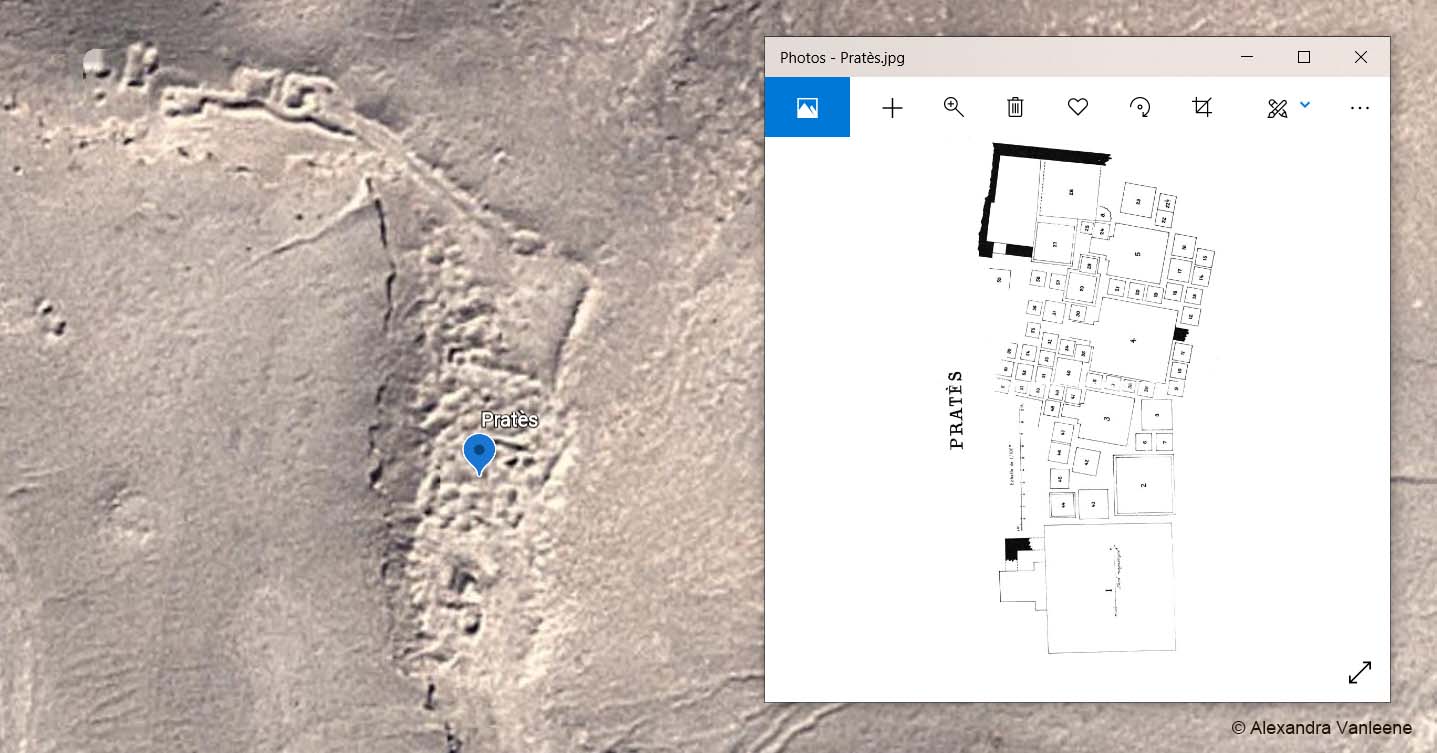
Perspective view of the plan of Pratès drawn by J. Barthoux (Barthoux, 1927) and the current state of the site according to Google Earth satellite imagery.
The small hill of Pratès (abbreviation: P) rises some 3 kilometres from the preceding sites. It was very uneven and the built area extended only about 60 metres. A known location, it had been looted for the turquoises of its relics, so the remains were thoroughly disturbed: the surface of the site was an expanse of rubble scattered by successive plundering, and the site had been covered with wind-blown sand.
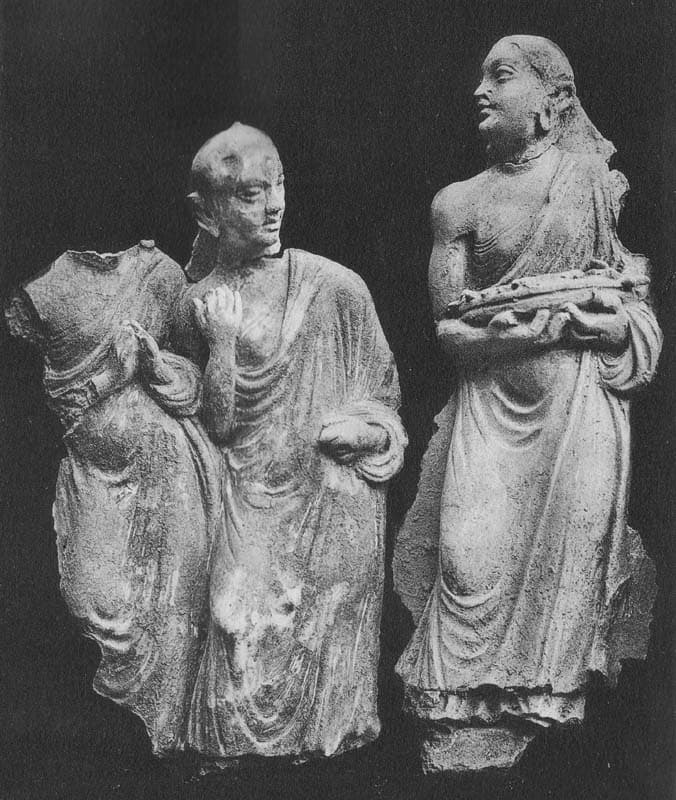
There is no way to determine whether an enclosure wall existed or not. The area presented itself as a multitude of stūpa built side by side, nearly abutting one another. They were arranged around two larger stūpa and formed two groups with slightly different orientations. At the southern end of the site, the Great Stūpa P1 was oriented to the west. Although in poor condition, it had nonetheless revealed figures painted in ochre and stucco Buddha 1.5 metres tall, whose haloes were marked in red. Its decoration evoked the Buddhas of the Past. The other group consisted of stūpa P 4, surrounded by two Great Stūpa P3 and P5 and a multitude of others, so tightly packed that the ritual of pradakṣiṇā was here again impossible. The dwellings stood on the northern side, in an arrangement parallel to that found at Chakhil-i Ghoundi. Another site, less extensive, lay to the north at a lower elevation. It had revealed Great Stūpa, but demolished down to ground level, so their excavation proved fruitless.
Explore the objects from this site in the database or on the interactive map.
Objects from this site
14 objects catalogued