Lālma
Plan of Lālma drawn by S. Mizuno (Mizuno, 1968).
Excavated by Seiichi Mizuno in 1965, the site of Lālma is situated to the south-west of the other sites, from which it is separated by a wide valley. It was chosen for its similarity to the other tepe and because looting threatened to ruin it entirely. Lālma revealed a Stūpa Court and numerous caves. The latter, generally consisting of a single room, rarely two, were entirely demolished but filled with fragments of modelled works and painted plasters.
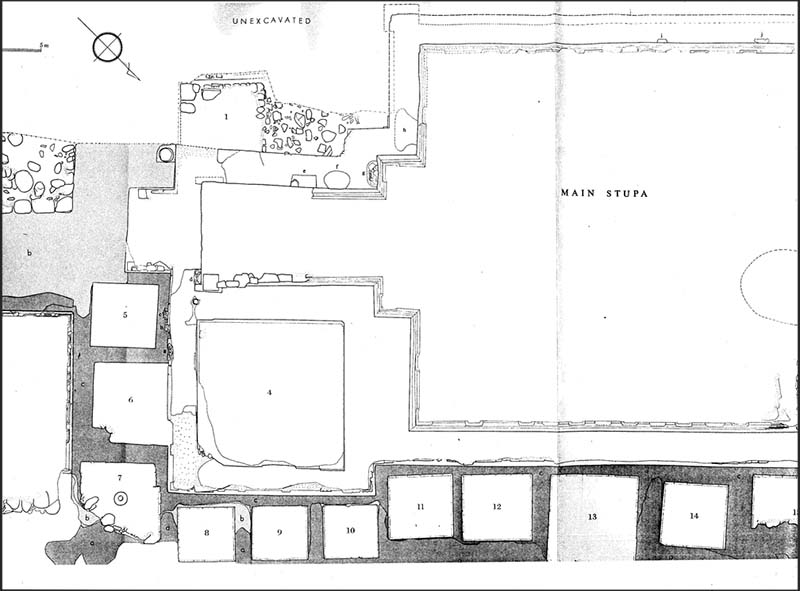
Built on a slightly projecting terrace reached by a few steps, like the Great Stūpa M of Tapa-e Shotor, the main stūpa measured 8.5 m on each side and had a staircase flanked by two secondary stūpa. At the foot of the platform, on the south-east façade to the right of the staircase, stood three stūpa. One was built against it, while the others left only a very narrow space between themselves and the terrace. Similarly, a series of eight stūpa stood on the north-east side. For lack of time, the other façades were not excavated. The projection of the terrace around the Great Stūpa and the absence of space between it and the secondary stūpa did not allow the ritual of pradakṣiṇā, as observed at several sites. The decoration of this stūpa was similar to what is found at all the sites of Haḍḍa. Small seated Buddha in dhyānamudrā were placed against the set-back of the staircase on the terrace. The first body of the main stūpa was articulated by pilasters delimiting eight panels. In each space stood a standing Buddha on a low pedestal flanked by two smaller identical Buddha. On either side of the staircase, trilobed niches sheltered Buddha in vitarkamudrā. The terrace was likewise adorned with seven modelled Buddha, standing with the hand emerging from the sinus of the collar, or seated. According to Mizuno, numerous heads of Buddha and Bodhisattva were found in the rubble, all identical to those from sites already excavated by Barthoux. The excavation was not extended; we therefore do not know whether the Stūpa Court was surrounded by an enclosure wall, whether it was pierced with niches, and/or whether it communicated with vihāra or other constructions. According to Kuwayama, the similarities between Lālma and Tapa-e Shotor suggest that these two sites were contemporaneous for a certain period. Mizuno dates the first period to the 4th–5th century CE and the second from the 5th century onward.
Explore the objects from this site in the database or on the interactive map.