History of the Excavations at Haḍḍa
Introduction
Haḍḍa (Pashto: هډه) is one of the most important Buddhist monastic complexes of the ancient world. Located approximately twelve kilometres south of Jalālābād, in Nangarhār Province, Afghanistan, this archaeological site extends over an area of approximately one square kilometre, dotted with artificial mounds, the tepe, that conceal the remains of monasteries, stūpas and chapels.
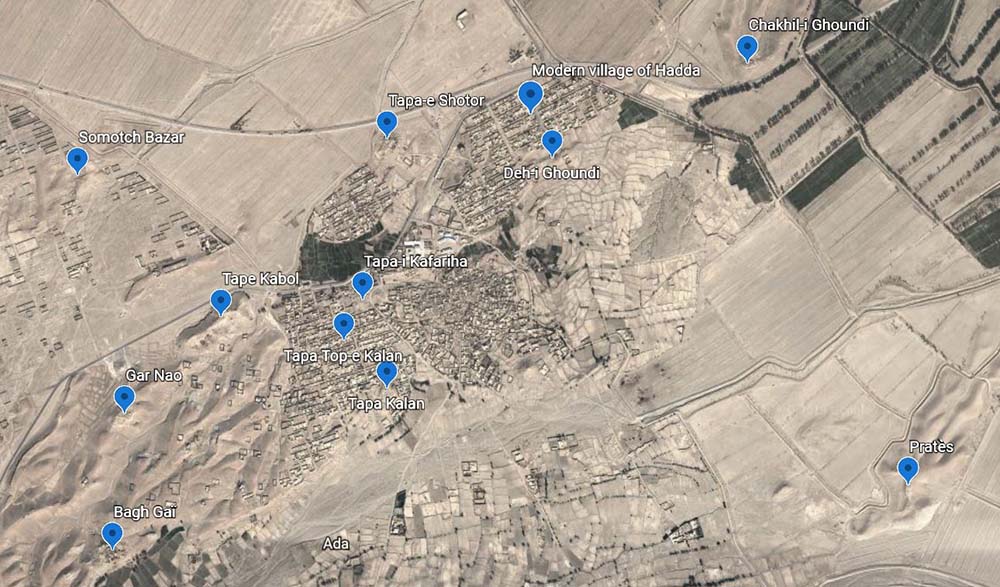
According to the Chinese pilgrim Xuánzàng (玄奘), who visited the region in 629–630 CE, Nagarahāra, the ancient name of the Jalālābād region, was home to a stūpa containing the Buddha's cranial bone (uṣṇīṣa), around which a flourishing monastic complex had grown. Haḍḍa was thus one of the major centres for the veneration of Buddha relics in the ancient Buddhist world.
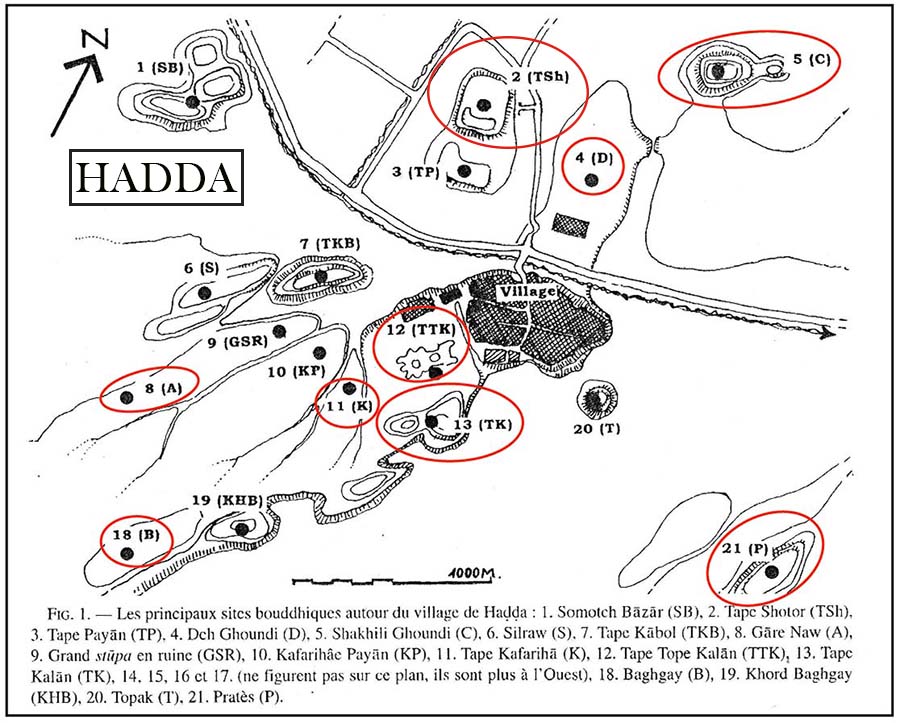
The history of excavations at Haḍḍa spans nearly two centuries, marked by exceptional discoveries, pioneering archaeological interventions and, tragically, by massive destruction. This article traces the major stages of this history, from the first explorations of the 19th century to the digital preservation efforts of the 21st century.
The Ancient Witnesses: Fǎxiǎn, Sòngyún and Xuánzàng
The earliest written descriptions of Haḍḍa come from two Chinese Buddhist pilgrims. Fǎxiǎn (法顯), who departed from Cháng'ān in 399 CE, crossed Central Asia and Gandhāra to reach India. In his Fóguó jì (佛國記, Record of Buddhist Kingdoms), he describes Nagarahāra (the ancient name for the Jalālābād region) as a major pilgrimage site, housing relics of the Buddha, a cranial bone, a staff and the Buddha's robe, venerated in edifices adorned with gold and lapis lazuli.
A little over a century later, around 520 CE, Sòngyún (宋雲), an envoy of the Northern Wei court sent to Central Asia in search of Buddhist texts, travelled through Gandhāra with the monk Huìshēng. His account bears witness to the enduring vitality of the Buddhist sanctuaries of the region, by then under Hephthalite rule.
A century later, Xuánzàng (玄奘) visited the region in 629–630 during his great journey to India. In his Great Tang Records on the Western Regions (大唐西域記, Dà Táng Xīyù Jì), he confirms the religious importance of Nagarahāra and mentions a stūpa containing the Buddha's cranial bone, around which a flourishing monastic complex was organised. The cult of relics, together with the donations it attracted, contributed to the enrichment of the monasteries and to their successive enlargements. He notes that several monasteries were already in decline, foreshadowing the slow abandonment that would intensify with the spread of Islam in the region in the 8th–9th centuries.
These ancient accounts played a decisive role for European archaeologists of the 19th and 20th centuries, who used them as guides to locate the sites.
Charles Masson (1832–1838)
The first archaeological exploration of Haḍḍa was undertaken by Charles Masson (born James Lewis, 1800–1853), a deserter from the British East India Company's army who reinvented himself as an explorer and numismatist. Between 1832 and 1838, Masson explored the Jalālābād plain and opened at least fourteen stūpas at Haḍḍa and its surroundings.
Masson was not an archaeologist in the modern sense, his methods were rudimentary and destructive, but his finds were remarkable. He discovered Graeco-Bactrian, Indo-Scythian, Kushan and even Roman coins, testifying to the region's commercial and cultural connections. He also unearthed reliquaries, sculptures and Kharoṣṭhī inscriptions. His collections were sent to the British Museum and the East India Company, where they remain a valuable resource for numismatists and historians of Gandhāra.
Masson published the results of his explorations in "A Memoir on the Buildings Called Topes" (1841), included in H. H. Wilson's Ariana Antiqua (p. 55–117), a work that drew European scholarly attention to Afghanistan's archaeological riches.
William Simpson (1878–1879)
Four decades later, William Simpson (1823–1899), a Scottish artist and war correspondent for the Illustrated London News, took advantage of the Second Anglo-Afghan War to explore the Buddhist remains of the Jalālābād plain. In 1878–1879 he excavated the stūpa of Ahin Posh and surveyed numerous mounds and caves around Jalālābād, publishing his observations in "Buddhist Remains in the Jellalabad Valley" (Indian Antiquary, 1879), followed by "Buddhist Caves of Afghanistan" (Journal of the Royal Asiatic Society, 1882). His drawings and surveys form a precious link between Masson's soundings and the scientific excavations of the 20th century.
Jules Barthoux and the DAFA (1926–1928)
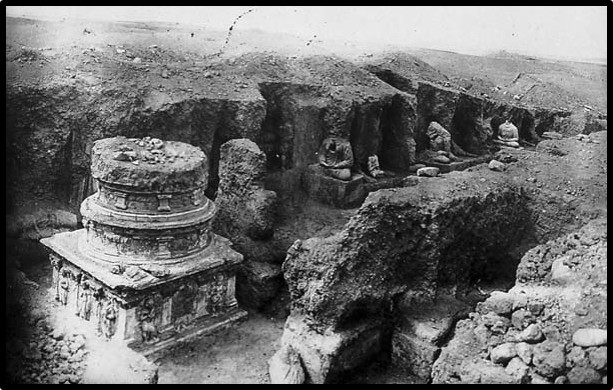
The most important phase in Haḍḍa's archaeology began in 1922 with the creation of the Délégation Archéologique Française en Afghanistan (DAFA), founded by Alfred Foucher under a bilateral agreement between France and King Amānullāh's Afghanistan. The DAFA enjoyed an exclusive monopoly on archaeological excavations in the country, a privilege that lasted until 1952.
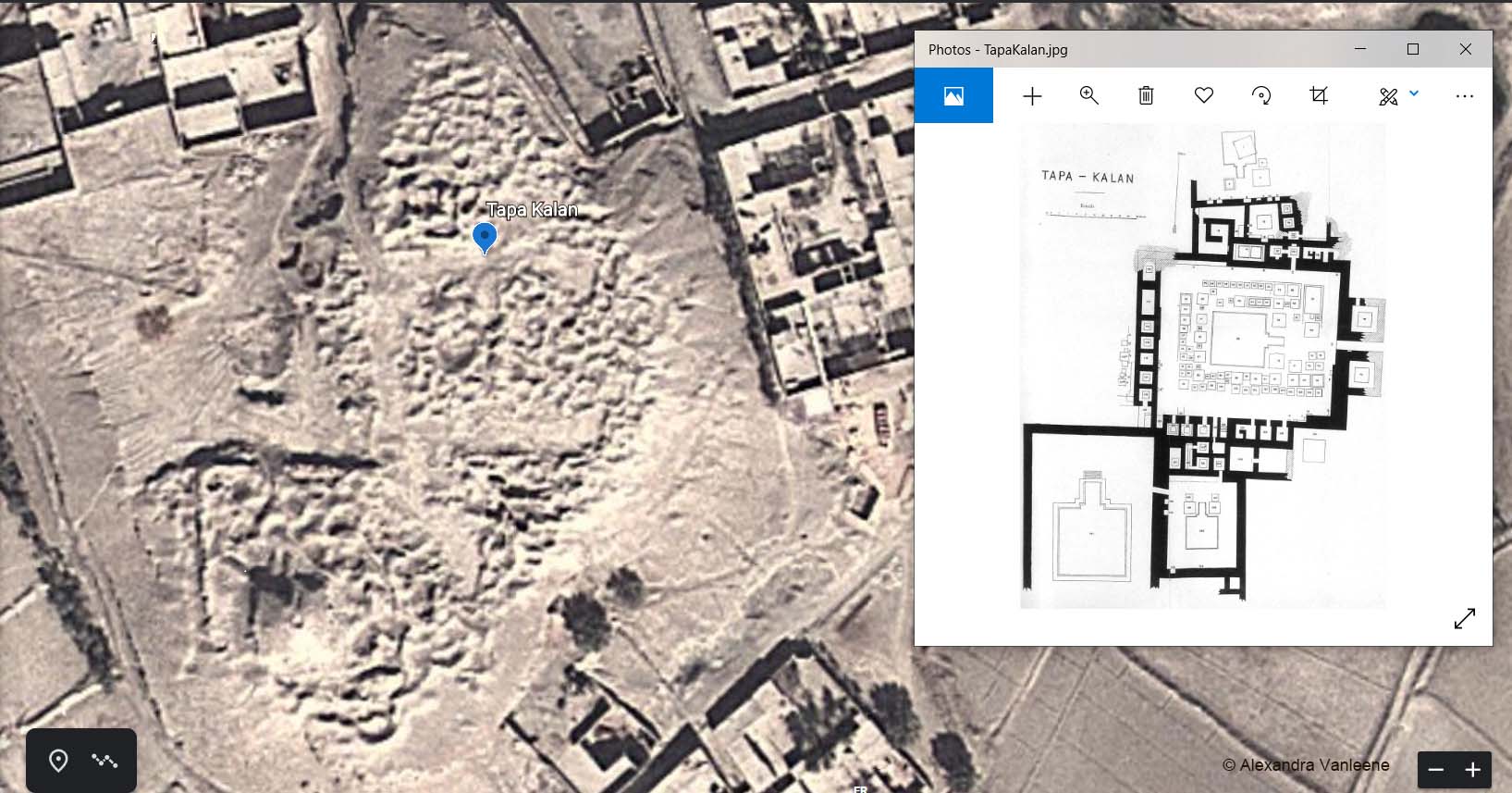
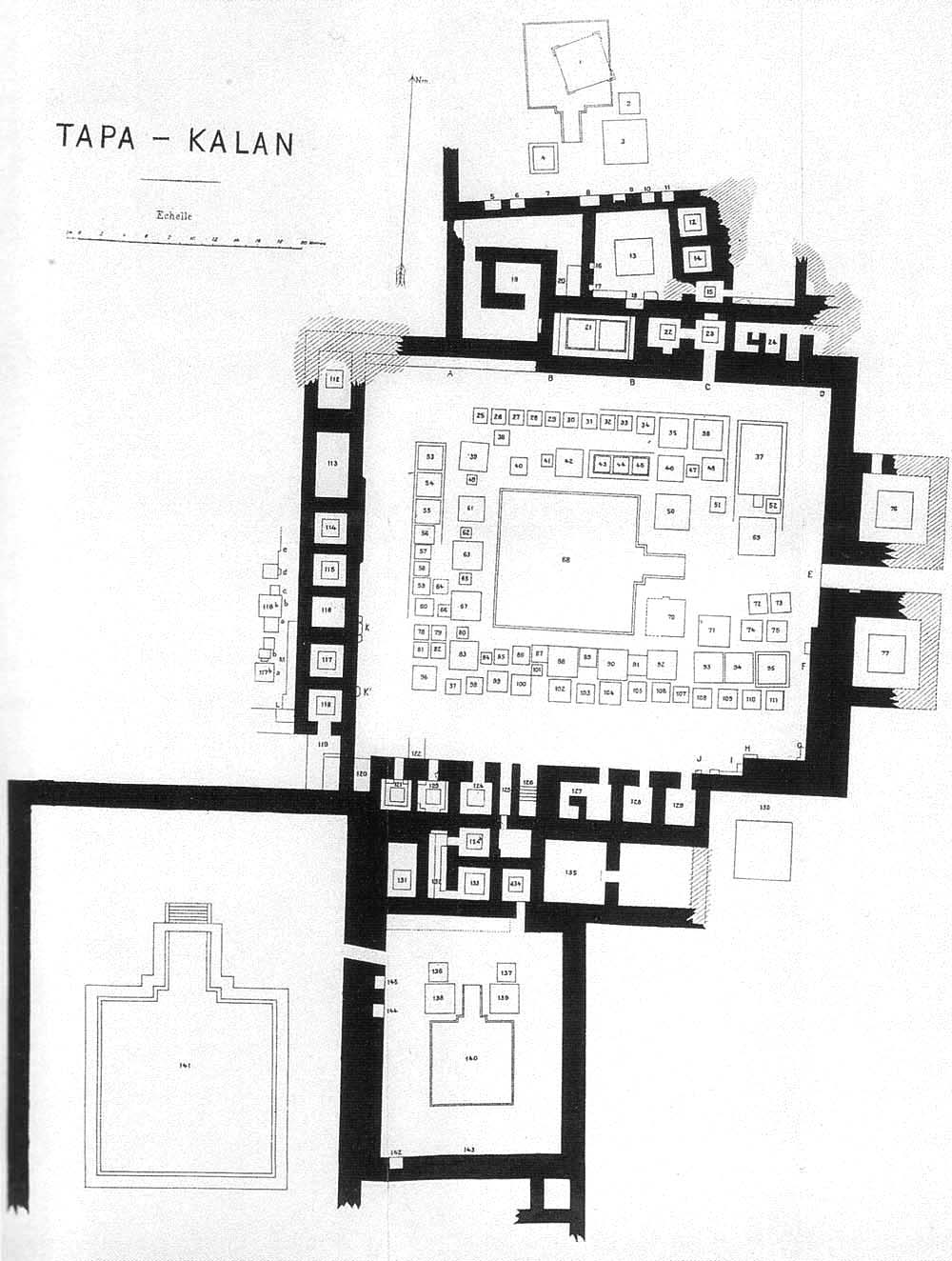
It was Jules Barthoux (1881–1930), a geologist and archaeologist, who directed the excavations at Haḍḍa between 1926 and 1928. In three intensive campaigns, Barthoux excavated eight monasteries, including Tapa Kalān, the largest, Tapa-i Kafāriha, Bāgh Gaï and Pratēs.
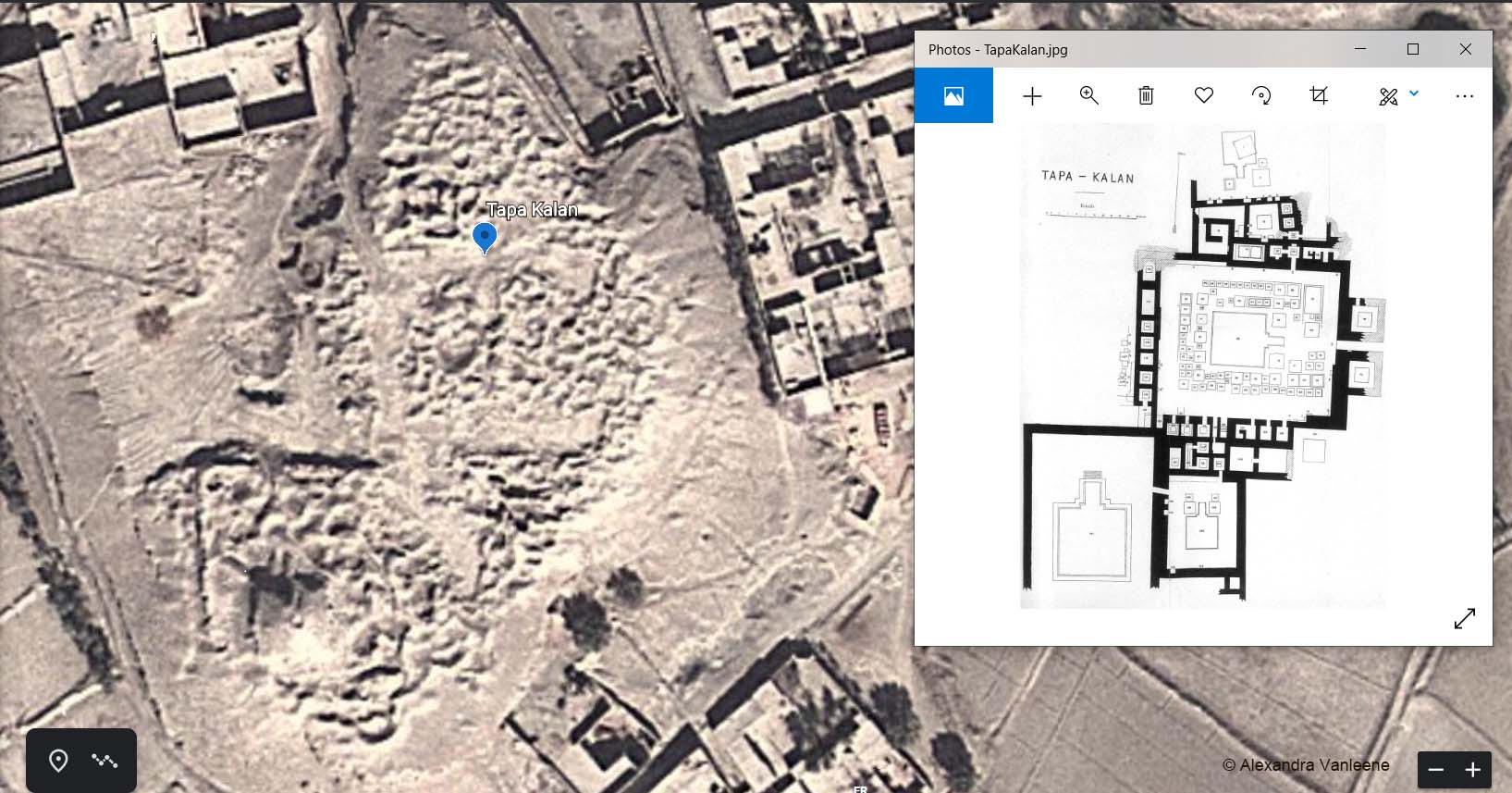
The results were spectacular: approximately 15,000 artefacts were unearthed, primarily stucco, unbaked clay and schist sculptures representing buddhas, bodhisattvas, deities and secular figures. Among the most celebrated pieces is the "Genius with flowers" (HADB 472), a minor deity with a childlike, gentle face holding up a flower, which has become one of the icons of the art of Haḍḍa.
Barthoux published two foundational volumes: Les fouilles de Haḍḍa, vol. I: Stūpas et sites (1933) and vol. III: Figures et figurines (1930), which remain indispensable references. A third volume dedicated to "Heads" was never published in his lifetime. The finds were divided into two halves: one remained at the Kabul Museum, where it formed the core of Afghanistan's Gandhāran collection, while the other entered the Musée Guimet in Paris.
The Afghan Institute of Archaeology (1965–1973)
After the end of the French monopoly in 1952, a new era opened for Afghan archaeology. In 1965, Shaïbaï Mostamindi, an Afghan archaeologist trained in France, undertook the first Afghan-led excavations at Haḍḍa, on the site of Tapa-e Shotor ("the camel mound"). These pioneering excavations marked the emergence of a national archaeology in Afghanistan.
In 1966, the Afghan Institute of Archaeology (AIA) was officially established, and Mostamindi continued his work until 1973. He uncovered important stratigraphic levels and stucco decoration of great refinement, demonstrating that Tapa-e Shotor still contained unexplored treasures. The most spectacular discovery was that of Niche XIII of the main stūpa, the famous "Niche with Nagas", which depicts the visit of the Buddha to a Nāga king in an aquatic setting. The composition of the scene "in depth" remains to this day a unique discovery in our regions. Blending Hellenistic influences with local traditions, it is considered an absolute masterpiece of Haḍḍa art.
Zémaryalaï Tarzi and Tapa-e Shotor (1974–1976)
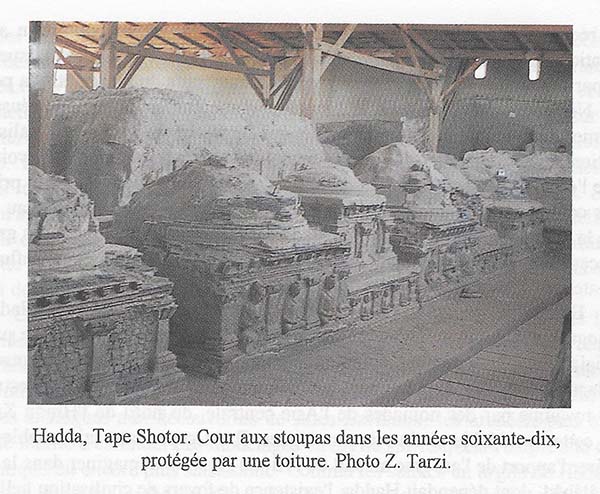
The most productive period of Afghan excavations at Haḍḍa was directed by Professor Zémaryalaï Tarzi, an Afghan archaeologist trained at the University of Strasbourg. Between 1974 and 1976, Tarzi conducted three systematic excavation campaigns at Tapa-e Shotor, revealing an exceptional ensemble of sculptural decoration in situ.
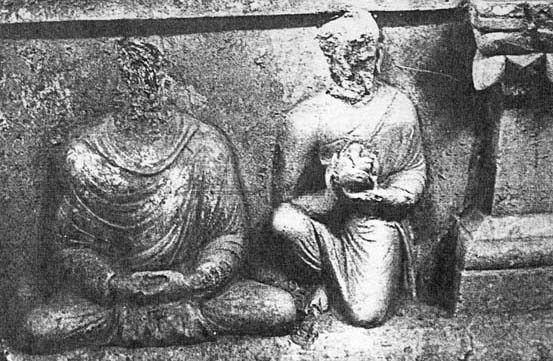
The major discovery was that of Niches V1, V2 and V3, populated with Buddhist characters modelled in clay. Niche V2 contained a remarkable Heracles-Vajrapāṇi, a hybrid figure combining the iconography of the Greek hero Heracles (club, lion skin) with that of the Buddhist protector Vajrapāṇi. This figure vividly illustrates the Graeco-Buddhist syncretism that characterizes Gandhāran art. In the same ensemble, a Hāritī with the features of the Greek goddess Tyche and a Vajrapāṇi with the features of Alexander the Great further embody this dialogue between the Greek world and Buddhism.
Tarzi also uncovered polychrome wall paintings, rare for the site, notably the painted decoration of Cave A, as well as Kharoṣṭhī inscriptions. His work demonstrated that the stucco of Haḍḍa constituted a missing link between Gandhāran Hellenistic stone sculpture and the clay and stucco traditions of Central Asia and India.
Destruction and Looting (1979–2001)
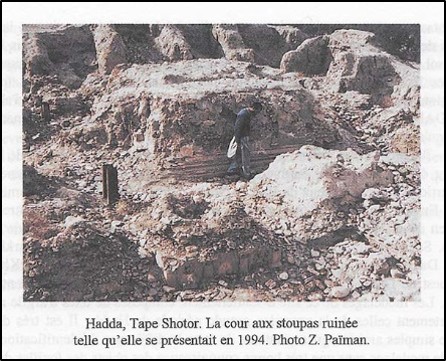
The Soviet invasion of December 1979 brutally halted all archaeological activity at Haḍḍa. Fighting between the Soviet army and the mujahideen devastated the Jalālābād plain. The Haḍḍa site, located in a combat zone, suffered considerable damage. Trenches were dug through archaeological remains, stūpas were used as firing positions, and bombardments destroyed entire structures.
After the Soviet withdrawal (1989), the ensuing civil war proved even more devastating for the heritage. Systematic looting multiplied, feeding the antiquities black market. Entire sculptures were ripped from their context and sold to collectors and art dealers in Peshawar, London and Switzerland.
In 1992, Niche V2 of Tapa-e Shotor, which housed the Heracles-Vajrapāṇi discovered by Tarzi, was destroyed and burned. This deliberate destruction of a unique archaeological context represents one of the most painful losses for the history of Gandhāran art.
The final blow came in March 2001, when the Taliban regime ordered the systematic destruction of all "idols" in the Kabul National Museum. More than 7,600 fragments of sculptures, primarily from Haḍḍa, were methodically smashed with hammers. Among the destroyed pieces were unique masterpieces of Graeco-Buddhist art, some dating from the 1st–5th centuries CE. This planned cultural destruction, occurring just days before the dynamiting of the Bāmiyān Buddhas, provoked unanimous international condemnation.
Preserving the Memory
Faced with the scale of destruction, the international community and researchers have mobilised to preserve the memory of Haḍḍa by all available means.
In 2006, the publication of the Tissot catalogue, Catalogue of the National Museum of Afghanistan, 1931–1985 by Francine Tissot, provided a systematic photographic inventory of the Kabul Museum's Gandhāran collection as it existed before the destructions. This work has become an irreplaceable reference tool for identifying lost and surviving pieces.
The Institute for the Study of Ancient Cultures (ISAC) at the University of Chicago, in partnership with the National Museum of Afghanistan, is documenting the sculptures of Haḍḍa within the NMA–ISAC Haḍḍa Sculptural Project, integrating data on Haḍḍa into digital resources accessible to the international scholarly community.
Research on Haḍḍa also continues today within the Digital Gandhara Project of Harvard FAS CAMLab, in which our team takes part. A pilot project devoted to the digital reconstruction of the Tapa-e Shotor monastery was presented at the international conference of the EASAA in 2024, and the immersive installation "Hadda" is on view at the Cleveland Museum of Art from 2026 onwards, as part of the Sacred Sites Revisited programme.
It is within this dynamic of digital preservation that the HADB (Hadda Archaeological Database) project takes its place. By assembling in a structured database all available information, photographs, descriptions, locations, publications, the HADB project aims to virtually reconstruct a largely destroyed collection and make it accessible to researchers, students and the public.
The stakes are considerable: without these digitisation and cataloguing efforts, a major part of Gandhāra's artistic and religious history risks falling into oblivion. Digital technologies today offer the possibility not only of preserving what remains, but also of reconnecting fragments dispersed across museums and collections worldwide, thereby restoring coherence and visibility to a heritage fractured by history.