Scene from the Buddha's life
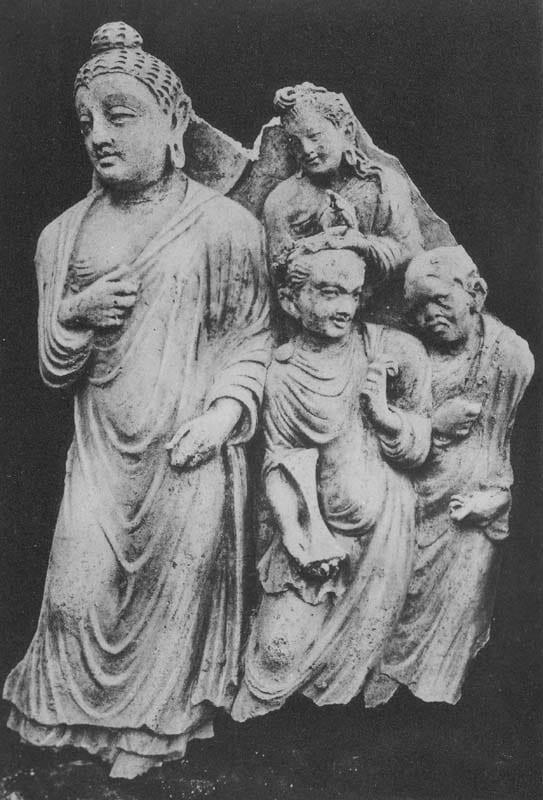
Photo by Jules Barthoux ©GrandPalaisRmn - Guimet Museum
Description
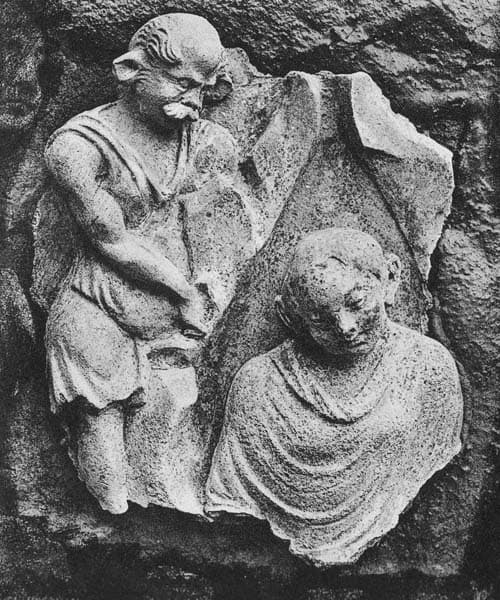
This bas-relief fragment depicts a scene from the life of the Buddha. He is standing looking to his right and sketching a gesture, original in Gandhāra art, but often encountered in Haḍḍa. The right arm is wrapped in the saṃghāṭi and the hand holds the reverse side at chest level. Below, the antaravāsaka can be seen. The face is idealised and bears the usual characteristics. The wavy hair and the uṣnīṣa is simplified and stylised by recessed half-moons. To the left of the Buddha stands Vajrapāṇi, holding the vajra resting against his palm and right forearm. He is depicted shaven and dressed as a bhikṣu, holding a flap of his garment pulled up over his shoulder with his left hand. He is facing a monk whose face is more individualised. His face is wrinkled, his eyes sunken, his pout gives him a serious look. He makes the same gesture as the Blessed One. Above them is a figure with long hair, partly raised on top of the skull, and with distended earlobes. He carries his hands clasped in anjalimudrā and is dressed in the uttarāsaṅga, which leaves the right shoulder uncovered. This is presumably the god Brahma, attending and blessing the scene. The folds of the clothes are represented with suppleness, underlining the curves of the body or the advance of the knee. These figures are not characteristic of any particular scene from the legendary life of the Buddha, so it is not possible to identify him more precisely.
Observations
In this relief, which is in the Kabul Museum, the head of Vajrapāṇi is now broken.
Characteristics
Technique
Modelling
Material
Stucco
Object type
Historiated scene
Site
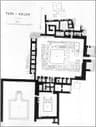
Tapa Kalān - 54
Conservation location
National Museum of Afghanistan
Museum inventory No.
MK 72
Traces of polychromy
No
Restoration
No restoration
Technique
Modelling
Material
Stucco
Object type
Historiated scene
Site
Tapa Kalān - 54
Conservation location
National Museum of Afghanistan
Museum inventory No.
MK 72
Traces of polychromy
No
Restoration
No restoration
Bibliographic Reference
Other objects from Tapa Kalān
Part of the themed routes