The Forgotten Buddhist Monasteries of Haḍḍa
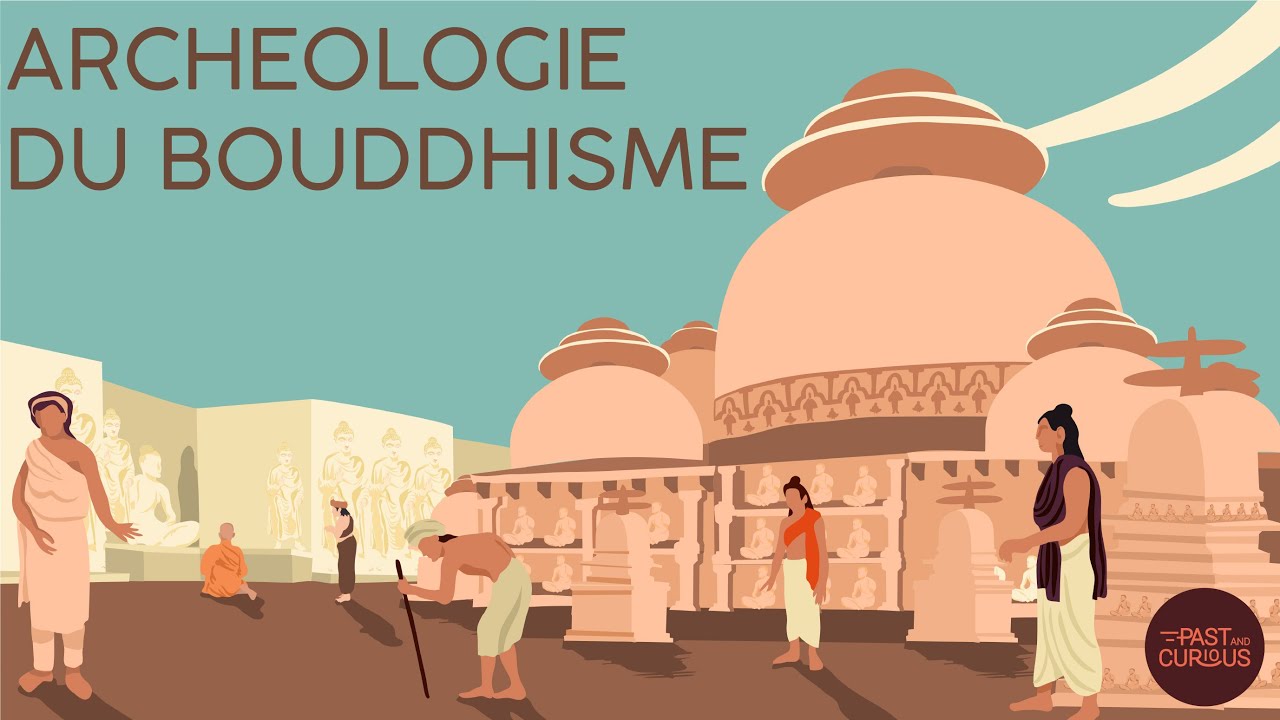
In September 2019, the YouTube channel Past & Curious, specialising in historical outreach through animation, released a remarkable video dedicated to the Buddhist monasteries of Haḍḍa, Afghanistan. Written by Alexandra Vanleene, archaeologist and specialist in Gandhāran art, this video invites viewers to journey through Buddhist Afghanistan, following in the footsteps of the pilgrim monk Xuanzang (玄奘), to discover an exceptional artistic heritage that has now largely disappeared.
Xuanzang (玄奘, 600/602–664) was one of the greatest Buddhist monks and sutra translators in Chinese history. Born in Luoyang, Henan, he was fully ordained as a monk in 622. In 629, he secretly left Chang'an (Xi'an) on a pilgrimage to India, defying Emperor Taizong's ban on foreign travel. His sixteen-year journey took him across Central Asia, Afghanistan and the entire Indian subcontinent.
While crossing Afghanistan, Xuanzang visited Bactres (Balkh), where he found over 3,000 Theravāda monks, then Bāmiyān, where he marvelled at the two giant Buddhas carved into the cliff face, destroyed by the Taliban in 2001. He continued to Kapisi (Begrām), capital of the kingdom of Kapisa in Gandhāra, which boasted over one hundred monasteries and 6,000 monks, before reaching Nagarahāra (Jalalabad), at the gates of Haḍḍa, where he considered he had finally reached India. His account, the Dà Táng Xī Yù Jì (大唐西域記, "Record of the Western Regions during the Great Tang"), provides an invaluable description of the Buddhist world as it began its decline. Returning in 645, he brought back 657 Sanskrit texts and supervised the translation of 76 works, totalling 1,347 scrolls, until his death. His journey inspired the famous novel Journey to the West (西遊記), one of the great masterpieces of Chinese literature.
The Video
The video is available with subtitles in French, English, Farsi and Spanish.
Haḍḍa and Gandhāran Art
Haḍḍa is a vast Buddhist monastic complex located in Nangarhar Province, in eastern Afghanistan, a few kilometres south of the city of Jalalabad. From the 2nd to the 7th century CE, the site housed hundreds of stupas and monasteries, forming one of the most important religious and artistic centres of the Gandhāra region.
Gandhāran art, born from the encounter between Hellenistic Greek artistic traditions and the Indian Buddhist world, produced some of the earliest anthropomorphic representations of the Buddha. Haḍḍa occupies a unique place in this art history: its stucco and unbaked clay decorations, of striking expressiveness, bear witness to a distinctive artistic school, separate from the schist productions of the Peshawar valley.
The first scientific excavations of the site were conducted by Jules Barthoux between 1926 and 1928, under the auspices of the Délégation Archéologique Française en Afghanistan (DAFA). His work led to the discovery of thousands of sculptures from major sites such as Tapa Kalan, Bagh-Gai and Tapa-i-Kafariha. Subsequently, campaigns by the Afghan Institute of Archaeology in the 1960s, followed by those of Zemaryalai Tarzi at Tapa-e-Shotor in the 1970s, further expanded our knowledge of this exceptional heritage.
Tragically, decades of conflict in Afghanistan have led to the destruction of many sites and the disappearance of a considerable portion of this heritage. It is in this context that documentation and research efforts such as those presented in this video take on crucial importance.
Alexandra Vanleene, Specialist in Gandhāran Art
The video script was written by Alexandra Vanleene, who holds a doctorate in archaeology from the University of Strasbourg. In 2011, she defended her thesis on the decorative programmes of the monasteries of Haḍḍa, emblematic of the Greco-Buddhist art of Gandhāra. Her research focuses in particular on the differences and similarities in Gandhāran artistic production, especially the modelling school of Haḍḍa.
Since 2021, Alexandra Vanleene has served as scientific advisor for the Digital Gandhāra project at Harvard University's CAMLab. She is also the founder of the Hadda Archaeo Database project, which aims to document and make accessible the entire archaeological corpus of Haḍḍa.
Past & Curious: Making Archaeology Accessible
Past & Curious is a YouTube channel dedicated to historical and archaeological outreach that distinguishes itself through the use of animation as a narrative medium. Through the illustrations of Astrid Amadieu and the animation and editing work of Maxime Garnaud, the channel succeeds in making complex subjects from ancient history accessible, offering visually rich and scientifically rigorous narratives.
This video on the monasteries of Haḍḍa perfectly illustrates this approach: by following in the footsteps of Xuanzang, the viewer is immersed in the daily life of Gandhāran monasteries and discovers the richness of its sculpted decorations. The animated format makes it possible to visually reconstruct spaces and artworks that, for the most part, now exist only in photographic archives and scientific publications.
The video has been translated into English by Pauline Debels, into Spanish by Areli Ayaviri and into Farsi by Bashir Ahmad Rustaqi, reflecting a commitment to international dissemination.
Credits
- Script: Alexandra Vanleene
- Production and direction: Past & Curious
- Illustration: Astrid Amadieu
- Animation and editing: Maxime Garnaud
- English translation: Pauline Debels
- Spanish translation: Areli Ayaviri
- Farsi translation: Bashir Ahmad Rustaqi
Bibliography
- BARTHOUX J., 1930. Les Fouilles de Haḍḍa, Figures et Figurines, Mémoires de la Délégation Archéologique Française en Afghanistan, Tome VI, Paris.
- BARTHOUX J., 1933. Les Fouilles de Haḍḍa, Stupas et Sites, Mémoires de la Délégation Archéologique Française en Afghanistan, Tome IV, Paris.
- MOSTAMINDI S., MOSTAMINDI M., 1969. “Nouvelles fouilles à Haḍḍa (1966-1967) par l'Institut Afghan d'Archéologie ”, Arts Asiatiques, Tome XIX, p. 15-36.
- TARZI Z., 1976. “Haḍḍa à la lumière des trois dernières campagnes de fouilles de Tapa-é-Shotor (1974-1976) ”, Comptes rendus des séances de l'Académie des Inscriptions et Belles Lettres, 120 (3), p. 381-410.
- TARZI Z., 1997. “Préservation des sites de Haḍḍa: monastères bouddhiques de Tapa Shotor et Tape Tope Kalān ”, MARI 8, p. 207-222.
- TARZI Z., 2001. “Le site ruiné de Haḍḍa ”, in Afghanistan, Patrimoine en Péril, actes d'une journée d'étude, CEREDAF, UNESCO, p. 60-69.
- VANLEENE A., 2012. “Haḍḍa, Kaboul-Kapiça, Bāmiyān: trois écoles artistiques de modelage entre l'Inde et la Chine ”, in G. DUCOEUR (éd.), Autour de Bāmiyān, de la Bactriane hellénisée à l'Inde bouddhique, Actes du Colloque de Strasbourg (19-20 juin 2008), Archeologia Afghana, p. 279-298, Paris.
- VANLEENE A., 2019. “Differences and similarities in Gandhāran art production: the case of the modelling school of Haḍḍa (Afghanistan) ”, in W. RIENJANG, P. STEWART (eds.), The Geography of Gandhāran Art, Proceedings of the Second International Workshop of the Gandhāra Connections Project, University of Oxford, 22nd-23rd March, 2018, Oxford, p. 143-163.