Return to Kapilavastu
©GrandPalaisRmn - Guimet Museum
Description
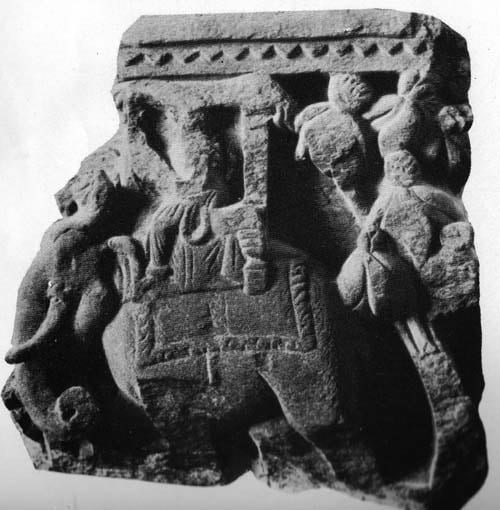
The left end of this partially broken bas-relief depicts a walking elephant leading a woman, recognisable by her anklets, and perhaps her child in a palanquin. It probably represents the return of Māyā, after the birth of Siddhārtha, to Kapilavastu. In Gandhāran art, this scene is frequently depicted, with or without the child in the palanquin. A flowering tree appears on the back of the mahout which is on the neck of the elephant, commemorating the birth.
Observations
The schist reliefs discovered by Barthoux between 1926 and 1928 are mostly from the vicinity of the Great Stūpa K1 of Tapa-i Kafarihā, the south-western part of the main stūpa B12 of Bāgh Gaï (around B13) and the Great Stūpa TK140 of Tapa Kalān.
Comparative study
HADB no. 443
Characteristics
Dimensions
H: 23cm × L: 19cm
Technique
Sculpture
Material
Schist
Object type
Historiated bas-relief
Site
Tapa Kalān - 140
Conservation location
National Museum of Afghanistan
Museum inventory No.
MK 3
Traces of polychromy
No
Restoration
No restoration
Dimensions
H: 23cm × L: 19cm
Technique
Sculpture
Material
Schist
Object type
Historiated bas-relief
Site
Tapa Kalān - 140
Conservation location
National Museum of Afghanistan
Museum inventory No.
MK 3
Traces of polychromy
No
Restoration
No restoration
Bibliographic References
Other objects from Tapa Kalān
Part of the themed routes