Dīpaṁkara Jātaka
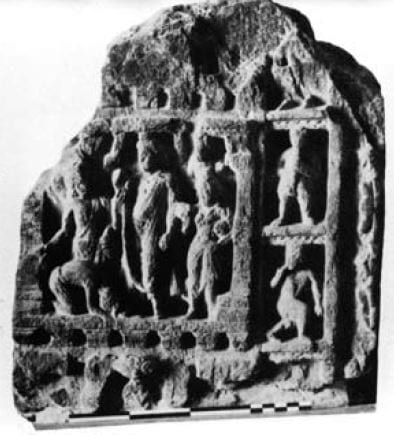

Description
It is a fragment in poor condition belonging to a historiated frame, broken at the top and bottom. The outer border is decorated with a vertical row of acanthus leaves and a band containing small naked figures separated by jagged cornices. One of the figures plays the flute (which seems to be a Gandharian innovation, it is not always carried by a character in Buddhist legend but is ubiquitous in Kuśan art (Marcel-Dubois, 1941: 94)), the other holds his hand to his mouth. Several registers were historiated: the only one preserved is one representing the Dīpaṁkara Jātaka. This account relates that in the mythical city of Amorn, the student Sumedha (or Megha) is said to have received from the Buddha of the past Dīpaṁkara ('The Lamp-bearer', 'The Bringer of Light') the prediction of his forthcoming incarnation in the guise of the Buddha Śakyamuni. At the centre of the scene is the Buddha Dīpaṁkara, without a nimbus, slightly taller than the other figures. Behind him stands Vajrapāṇi, bearded, and in front of him a young girl carrying a jug, certainly the one who sold flowers to the Bodhisattva. The latter, still a novice, is depicted at three moments in the legend: first standing, he throws a flower to the Buddha, then kneeling and throwing his hair to allow him to cross the puddle, finally after the prediction he is transported into the air, close to the Buddha's head. All details have been dropped in this painting: neither the girl's house, nor the haggling for the flowers, nor their miracle are depicted. Vajrapāṇi himself appears only to balance the composition, as does the girl who does not occupy her usual place on the other side of the scene. In Gandhāra art, this narrative is frequently depicted in the form of a continuously narrated picture. Most often the Buddha Dīpaṃkara is in the centre, surrounded by Vajrapāṇi and a flower seller, sometimes in front of his house, in some cases one or two monks may be added. Added to this scene is the triple, quadruple or even quintuple presence of the young Brahmin novice Sumedha, the future Buddha Śakyamuni.
Observations
According to tradition, the Dīpaṁkara Jātaka was held in the Nagarāhāra region, which seems to explain its success in Haḍḍa. Indeed, since the Buddha never came to Gandhāra, it must have created its holy places (and presumably some, if not all, of its relics), most often based on the Buddha's previous lives, especially the "prophetic" Jātaka such as the Dīpaṁkara Jātaka and those recounting the great sacrifices, such as the Śibi Jātaka.
Comparative study
HADB n°465
Characteristics
Dimensions
H: 39cm × L: 31cm
Technique
Sculpture
Material
Schist
Object type
False gable
Site
Haḍḍa, lost location
Conservation location
National Museum of Afghanistan
Museum inventory No.
MK 74
Traces of polychromy
No
Restoration
No restoration
Dimensions
H: 39cm × L: 31cm
Technique
Sculpture
Material
Schist
Object type
False gable
Site
Haḍḍa, lost location
Conservation location
National Museum of Afghanistan
Museum inventory No.
MK 74
Traces of polychromy
No
Restoration
No restoration
Bibliographic References
Other objects from Haḍḍa, lost location
Part of the themed routes