Male nude
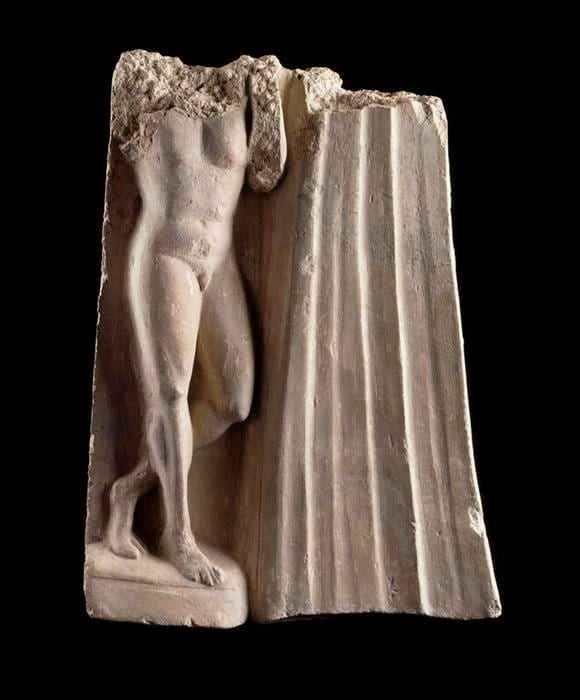
Photo by Thierry Ollivier ©GrandPalaisRmn - Guimet Museum
Description
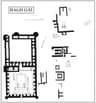
To the east of the main monastery of Bāgh Gaï stood the important vihāra 56, which housed a stūpa. Part of its decoration was dedicated to the modelled depiction of a mokṣa ceremony. A monumental and unfinished mural painting of the Conversion of Aṅgulimāla was also brought to light there. Drawings and photographs by Barthoux make it possible to reconstruct part of the décor of its inner enclosure.
In section C, a recess measuring 25 × 65 cm preserves the remains of a niche that once housed a draped throne, likely occupied by a seated Buddha. The drapery was held at each corner by two carefully modeled figures, while on the lateral walls, two small pedestals supported donors wearing Kushan boots.
The male figure is entirely nude and displays a musculature that reflects the influence of Western aesthetics. Its aesthetic treatment is refined. The contrapposto is accentuated: the right leg is extended forward, while the left is bent backward. The left arm, raised and held close to the body, supported the drapery of the throne. The anatomical rendering is particularly meticulous, especially in the modelling of the pectoral and abdominal muscles, the knee joint, and the calf. Its symmetrical counterpart (HADB 483) exhibits a slightly less refined treatment, particularly in the modelling of the legs.
1928 / today
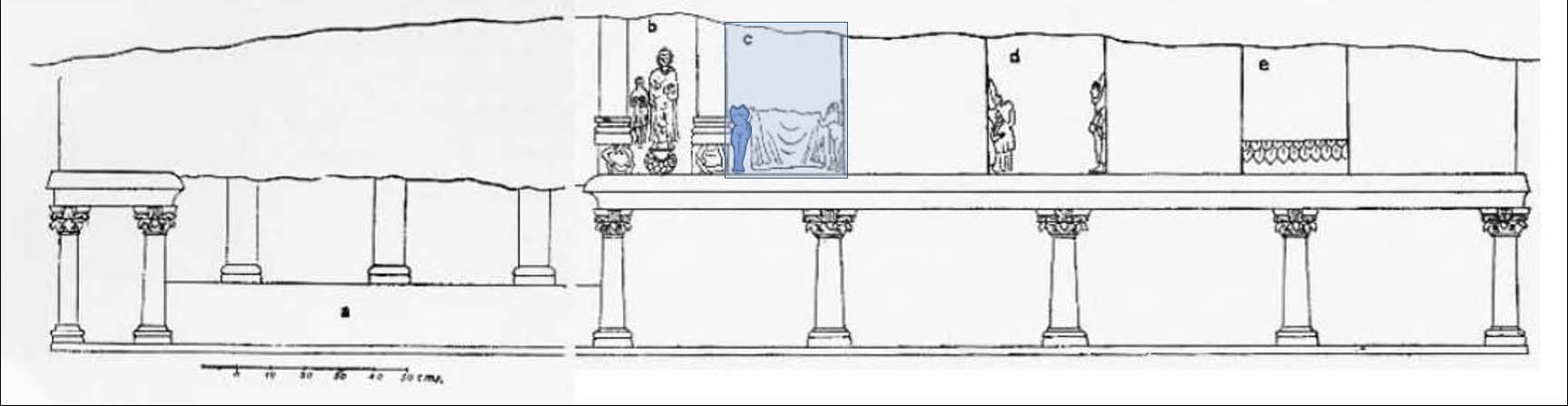
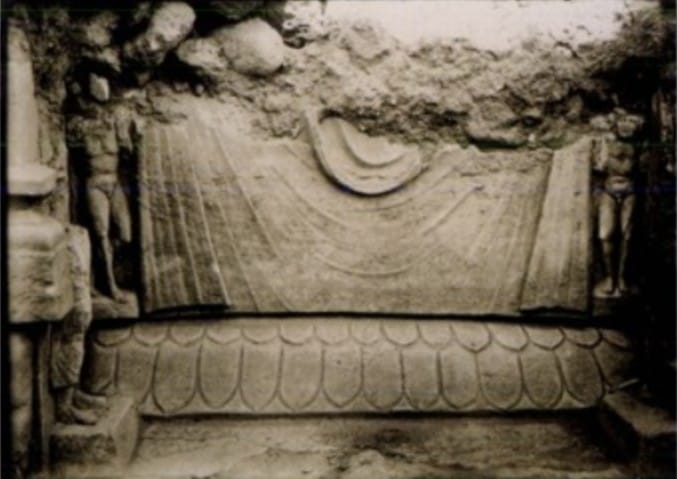
Excavation photograph by Jules Barthoux (1928) juxtaposed with a recent photograph by Alexandra Vanleene.
Characteristics
Dimensions
H: 24cm × L: 16cm
Technique
Modelling
Material
Stucco
Object type
Figure
Site
Bāgh Gaï
Conservation location
Guimet Museum
Museum inventory No.
MG17232
Traces of polychromy
No
Dimensions
H: 24cm × L: 16cm
Technique
Modelling
Material
Stucco
Object type
Figure
Site
Bāgh Gaï
Conservation location
Guimet Museum
Museum inventory No.
MG17232
Traces of polychromy
No
Other objects from Bāgh Gaï
Part of the themed route